St. George’s, January 14, 2010 – The Grenada Government’s attempt to revise the school curriculum to better equip students for the modern working world is receiving overseas assistance.
An agreement has just been signed for the receipt of US$113,000. The money, from the Government of Japan, is being made available through the UNESCO/Japanese Funds-in-Trust.
A signing ceremony Wednesday in St. George’s was attended by Grenada educational officials, including Minister of Education and Human Resource Development, Senator Franka Alexis-Bernardine; Senator Arley Gill, Minister of State with responsibility for Information, Information Technology and Culture; representatives of the Japanese Embassy in Trinidad and of UNESCO’s Cluster Office in Jamaica, and Secretary General of the Grenada National Commission for UNESCO.
Senator Alexis-Bernardine said the signing comes at an opportune time, and described the assistance as a significant step forward in the curriculum reform process.
“We are happy that UNESCO and the Japanese Funds-in-Trust have recognized the need for refocusing of Grenada’s School Curriculum and have approved the funding for this process,” she said.
The curriculum refocus, when completed, will place greater emphasis on personal development and technical skills’ training for students. It will also encourage more learning in arts and culture.
The cultural component has the complete support of Senator Gill. He noted that in the area of carnival arts, many have been lamenting the decline in the quality of costumes during the annual celebration.
However, he said very little has been done to ensure that quality in costume-designing is maintained and the skills taught to youngsters.
“The Ministry of Culture welcomes this initiative,’’ he said. “We are committed to the introduction of culture in Grenada’s mainstream education curriculum, starting with the introduction of carnival arts and, in particular, pan and costume-design and construction.”
Senator Alexis-Bernardine gave her ministry’s commitment to work closely with the Ministry of Culture on implementation of the cultural component of the project.
Dr. Kwame Boafo, Director of UNESCO’s Cluster Office in Jamaica, said while the funding has been a long time coming, he is happy that it has now been delivered to the Grenada Government.
“It is always good to regularly take a look at the curriculum to reform it,’’ he said, “to restructure and to revitalize it to ensure that students do have the necessary skills, the necessary knowledge that would make them productive citizens of the country. We are pleased with this particular reform because it comes at an appropriate time.”
The Ministry of Education embarked on refocusing the school curriculum following a World Bank report.
The report, issued in February 2008, suggests that Grenada has the most severe skills’ gap in the western hemisphere. It identified personal development and technical skills as the biggest deficit areas.
Among the areas in which emphasis will be placed under the revised curriculum are virtues and values training, anger management, conflict resolution, entrepreneurial skills, tourism training and culture.
The Ministry of Education says the inclusion of these areas in the curriculum will not mean additional work for teachers. The ministry is collaborating with members of the public sector to help teach and deliver the new subjects to students.
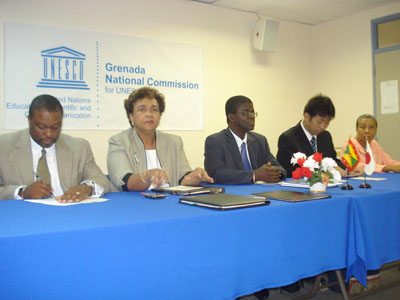
(Above: Members of the Head Table (left to right): Senator Arley Gill, Senator Senator Franka Alexis-Bernardine, Dr. Kwame Boafo , Mr. Atsushi Miura (Embassy of Japan), and the Permanent Secretary of the Ministry of Education).
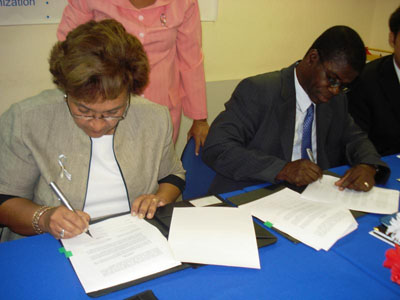
(Above: Senator Franka Alexis-Bernardine and Dr. Kwame Boafo)
 Embassy of Japan in Trinidad and Tobago